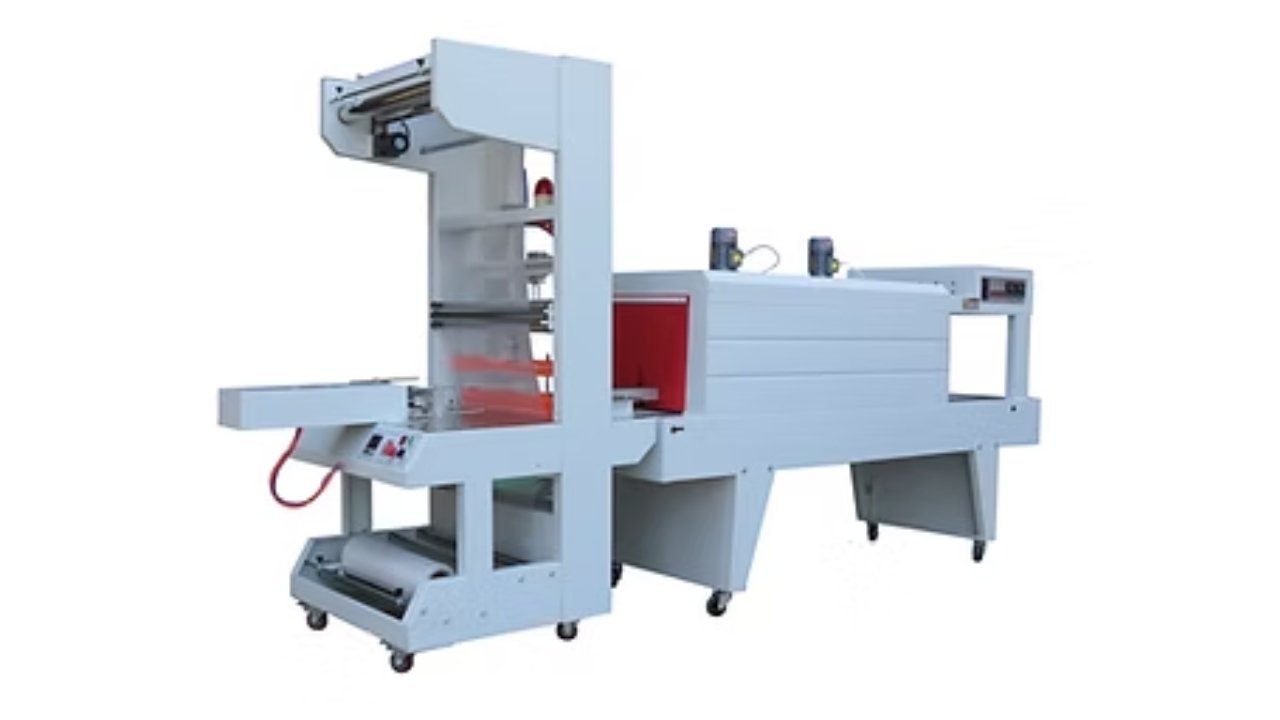
When you are going for a shrink wrap machine, you must have a good grasp of every part and its function. They may appear as simple machines but are in fact a complex network of coordinated elements working in perfect synchrony.
What Is A Shrink Wrap Machine?

We can define it as a semi-automated or fully automated machine that puts a product inside a special plastic film. This can be in the form of either polyethylene, polyolefin, or PVC, which is heated, causing it to shrink tightly around the product.
You probably have noticed this in food trays in supermarkets, electronic cases, and many other applications. We are to have an in-depth look at the important elements in this machine cycle, and their contribution to the magic of shrink wrapping.
Major Parts Of A Shrink Wrap Machine

When we look at a shrink wrap machine, it is possible to separate it into three primary parts:
- Film Handling and Feed Section: This is where the plastic film is fed into the machine
- Sealing Section: This section surrounds the product with film and uniformly cuts it.
- Shrink Tunnel / Heat Chamber Section: the film is shrunk here, sealing the final product to fit.
Key Components
· Film Roll/Unwind Shaft
This is where it all begins, with the roll of shrink film being kept in place by the film roll holder, which we also refer to as the unwind shaft. The main purpose of this component is to push the shrink film into the wrapping section.
It also contains tension rollers that prevent your film from wrinkling or snapping while wrapping. Ensure that your film roll is always aligned in the middle to avoid uneven wrapping.
· Film Guide Rollers and Dancer Arms
As the film rolls off, it goes over guide rollers that ensure that it is well aligned and, in the direction taken before it gets to the sealing space. Dancer arms are usually linked to sensors that control the tension of the film automatically.
They ensure that no matter what size item you are wrapping, the film feed remains smooth. In case you notice a film slippage or bunching while operating your machine, just look at the alignment of your guide rollers, which may also be worn.
· Film Folding Device
We have machines that involve the use of center-folded shrink film, where the film is folded lengthwise in half. The film-folding device is used to unfold and wrap it around the product.
When your machine has a slot for single-wound film, then this device is not applicable. You’ll instead have a film-forming collar, or a forming plow, which assists in wrapping the film around the product.
· Product In-feed Conveyor
This is the conveyor that feeds the products to the wrapping area and can either be a manual or semi-automatic system. For the automatic system, sensors and motorized belts serve a significant purpose, with the sliding guides able to be adjusted to suit your various product sizes.
Additionally, they contain photoelectric sensors that detect the presence of products to synchronize the sealing process. The speed is also regulated to ensure the sealing and film feed rates are in tandem.
· Sealing Bar/Sealing Jaw
This is the core of the sealing system that slices and puts the film around your product. They vary in shape and design based on your type of machine, with examples such as:
- A straight bar if your machine creates continuous side-sealing
- L-Shaped sealer if your machine seals your product on both sides simultaneously
The bar is first heated using a nichrome wire and melts the two layers of film while cutting any excess in a single cycle. In some machines, you can minimize power consumption by using impulse sealing or electric pulse heat.
· Sealing Wires
In this component, a wire or Teflon tape is applied to seal the slot or aperture, making the product remain completely airtight and solid. The sealing bars contain Nichrome sealing wires that produce the heat to melt the film, and Teflon insulation tape under them.
The Teflon tape gives the cleaning tooth an anti-film coating to avoid the accumulation of film. When your seals are crooked or the film burns up, it is normally indicative that you’re sealing wire is broken or that the Teflon tape has deteriorated.
· Cooling Fans
After the seal has been created, small cooling fans blow gusts of air to solidify while passing the product through the shrink tube before the seal can become distorted. This is very significant and critical in obtaining a product appearance that is neat with professional results.
· Shrink Tunnel/Heat Chamber
This is a very significant component as it is the heated station that passes high-temperature air used to shrink the plastic film over your product. It mainly uses either gas burners or electric heating elements.
The key components that make up the shrink tunnel are heating elements and blower fans to ensure even distribution of hot air. A conveyor belt is used to transmit your product through the tunnel, and a temperature regulation system controls the temperature inside.
· Tunnel Conveyor System
Since it is continuously exposed to high-temperature air, the conveyor system has to be resistant to such temperatures to continuously convey your products. It is usually made of Teflon mesh with silicone rollers or stainless-steel wire mesh.
· Cooling Section
Just after leaving the hot tunnel, your product is taken through a cooling area containing numerous fans that blow air over it, ensuring the film is well set. If this step is not properly carried out, your product may contain distorted or soft wraps.
· Central Panel/HMI
This is what you use to control the machine, with modern versions having digital touchscreen human-machine interfaces (HMIs). They give you access and control over parameters such as the intensity of air circulation, speed of the conveyor, the cycle timers, tunnel heat levels, and more.
You can also find sophisticated systems that can offer you programmable default settings if you are dealing with different types of products. Additionally, they contain fault detection, alarms, and diagnostics for predictive maintenance.
· Safety Interlocks/Sensors
These are put in place to ensure both your safety while operating the machine and the precision of the whole process. They include photoelectric sensors that detect the product to sync its wrapping, and temperature sensors to regulate both tunnel and heating temperatures.
They also contain overheat protection to shield them from fire and electrical hazards. Ensure that all your interlocks and sensors are always on during operation to avoid compromising your safety.
· Drive Motor and Gear Systems
If you get a machine with servo motors controlling the motion around your wrapping operation, then you are assured of precision and regulated control. However, the semi-automatic variants work well with both induction motors (AC) and stepper motors.
Optional Parts You May Encounter

- Automatic Film Cutting Machines: mostly used in shrink wrap machines that do not have manual trimming
- Perforation Rollers: They are used to poke very tiny holes in the plastic films to get rid of any air while shrinking, resulting in a well-fitting wrap.
- Product Pushers: They are not very common, but you can use compressed air to push your products into the sealing zone.
- Pre-heaters: They assist in prior heating of the tunnel to stabilize the temperature before the shrink wrap process begins.
- Labelers or Printer: They can assist you in adding labels or barcodes to your shrink-wrapped products
Maintenance Tips For Common Wear

| PART | ISSUE | MAINTENANCE TIP |
| Sealing wire | Burning out or breaking in use | Regularly replace depending on the rate of usage |
| Teflon Tape | Contaminated seals or film sticking | Weekly replacement or when required |
| Film Rollers | Poor alignment, dust accumulation | Regular cleaning, inspect bearings |
| Blower Fans | Irregular noise, overheating | Regular inspection and maintenance |
| Conveyor Belt | Jerking during movement | Regular cleaning and checking the tension |
| Temperature Sensors | Wrong readings | Calibrate every 3-6 months |
| Heating Elements | Uneven heat distribution in the tunnel | Check output and replace if low |
FAQs

Do you have replacement parts for shrink wrap machines?
Yes, whether you want to replace conveyor systems, film rollers, cutter blades or seals, you will find all types of replacement parts for your machines.
What materials are used for shrink wrap?
There are many material options, however, some of the most common materials are polyvinyl chloride, polyolefin, and polyethylene.
Which part of shrink wrapping machine commonly fails?
Although these machines are designed to last, heating element in heat tunnel and seal bar are subjected to temperature cycling which contributes to wear. This is the reason why you will find many operators replacing this part.
What causes the wrap film to tear during packaging?
You should check the film unwind brake which can cause excessive tension on the film. Under such circumstances, it causes tearing in the film. At the same time, ensure the film paths are aligned.
Flexshrink, your Trusted Shrink Wrap Machine Manufacturer in China

At Flexshrink, we offer many packaging solutions from manual shrink wrap machine, semi-automatic shrink wrapping machine to fully automatic shrink wrapping machine.
We design every shrink wrap machine to meet the dynamic needs in the modern packaging industry. Furthermore, our engineers work with your team for a custom-solution in the shrink wrap packaging.
For every machine you purchase from Flexshrink, you get technical support and the replacement parts are also available.